
Exam Accommodations: The Ultimate Guide for the LSAT, MCAT, and Bar Exam
Securing exam accommodations for the LSAT, MCAT, and Bar Exam requires submitting a comprehensive psychoeducational evaluation that proves a disability substantially limits your ability to test under standard conditions. While many students assume a doctor's note or past IEP is enough, high-stakes testing boards demand rigorous, updated documentation. Below, we walk through exactly what these institutions require, how to prepare your application, and what to expect during the evaluation process.
What Are Exam Accommodations?
Testing accommodations are legally mandated adjustments to standard testing conditions that allow individuals with disabilities to demonstrate their true aptitude. The Americans with Disabilities Act (ADA) requires that exams be administered so that results reflect your actual knowledge, rather than reflecting your attention deficits, anxiety, or impaired reading, writing, or math skills.
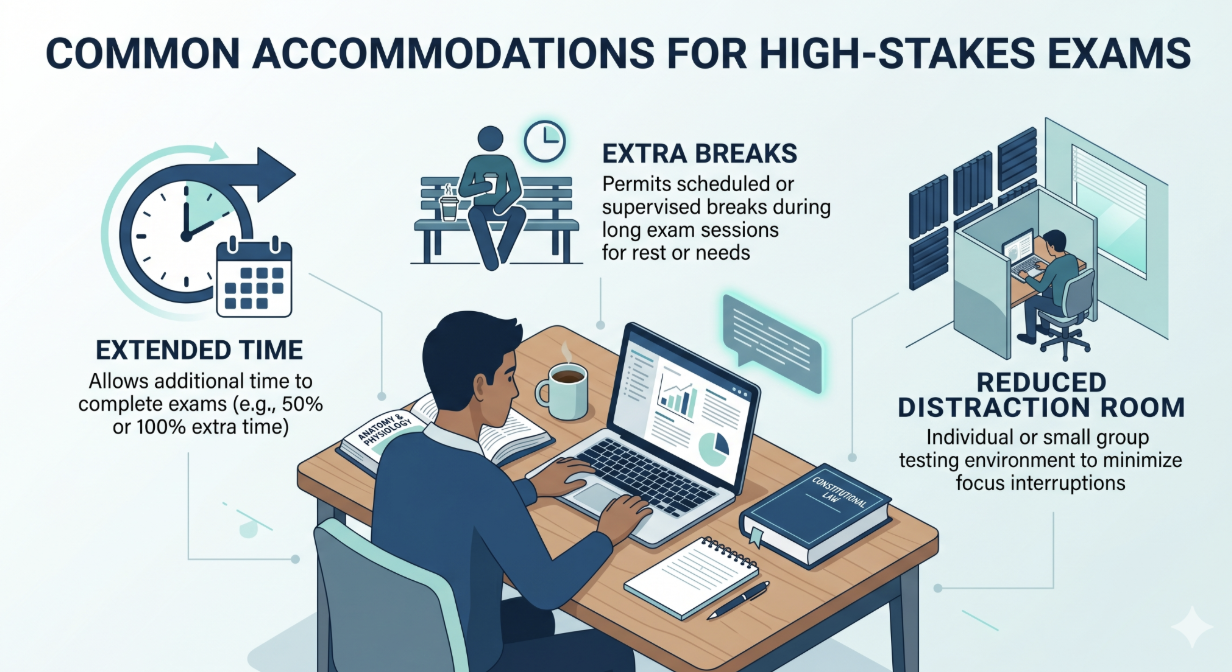
Common exam accommodations include:
- Extended time (e.g., 50% or 100% additional time)
- Extra or extended breaks
- A reduced-distraction testing environment
- Use of assistive technology (like a screen reader)
- Permission to use a computer for written essays
What Conditions Qualify for Testing Accommodations?
You can qualify for accommodations if you have a physical or mental impairment that substantially limits a major life activity, such as learning, reading, concentrating, or thinking. High grades do not disqualify you. According to the ADA, a history of academic success does not mean you do not have a disability.
Commonly evaluated conditions include:
- ADHD: Difficulty sustaining attention or managing impulses under time pressure.
- Specific Learning Disorders (Dyslexia, Dysgraphia, Dyscalculia): Slow reading, difficulty with written expression, or impaired math calculation.
- Psychiatric Disorders: Severe test anxiety, depression, or PTSD that causes cognitive obstruction.
- Autism Spectrum Disorder (ASD): Sensory sensitivities or cognitive inflexibility.
- Physical or Medical Conditions: Visual impairments, hearing loss, or motor impairments.
The Exact Documentation You Need for the LSAT, MCAT, and Bar
Testing organizations have incredibly specific demands. A brief letter from your doctor or a childhood 504 Plan is rarely enough on its own. They require a comprehensive evaluation that includes a clear diagnosis, standardized test scores, and a detailed rationale linking your functional limitations to the requested accommodations.
LSAT Accommodation Requirements
The Law School Admission Council (LSAC) categorizes requests based on the amount of extended time or accommodations needed. For learning disabilities, ADHD, or psychiatric conditions, your documentation must be no more than five years old. If your disability is physical or visual, documentation from anytime after age 13 is generally accepted. Your evaluator must complete the extensive "Qualified Professional Form," outlining your diagnosis and providing a written statement substantiating the need for accommodations like 50% extended time or a paper-and-pencil format.
MCAT Accommodation Requirements
The Association of American Medical Colleges (AAMC) is notoriously strict. For an ADHD evaluation, they specifically require measures of both intelligence (IQ) and academic achievement, but interestingly, they do not require processing speed testing for ADHD.
- ADHD: Evaluations must be administered no more than three years prior to the anticipated exam date.
- Psychiatric Disabilities: Evaluations must be no more than six months old, though documentation between 6 and 24 months old may be accepted if accompanied by a recent update letter from your evaluator.
Bar Exam Accommodation Requirements
State Bar associations, including the State Bar of California, place heavy consideration on your history of past accommodations (like in law school). However, if you are requesting greater than 100% additional testing time or a private room, the State Bar requires an exceptional justification. The key to the Bar Exam is the "nexus." Your evaluator must clearly explain the connection between the requested accommodation and your functional limitation; simply naming a diagnosis like ADHD will result in a denial.
Documentation Currency Quick Reference

Is Extended Time Always Best?
Many students automatically assume that extended time is the ultimate solution to their testing struggles. However, more time is not always the right answer.
If you have ADHD or a medical condition, requesting double time on an already grueling 7-hour exam like the MCAT or Bar Exam can actually induce severe mental fatigue and burnout. In many cases, "stop-the-clock" breaks are far more effective. Testing institutions view extended time as a way to process test content (e.g., for dyslexia or slow processing speed), whereas extra breaks are granted to manage a condition (e.g., regulating attention, resting, or taking medication). Requesting the wrong type of accommodation can lead to outright denials.
The Evaluation Timeline: Step by Step
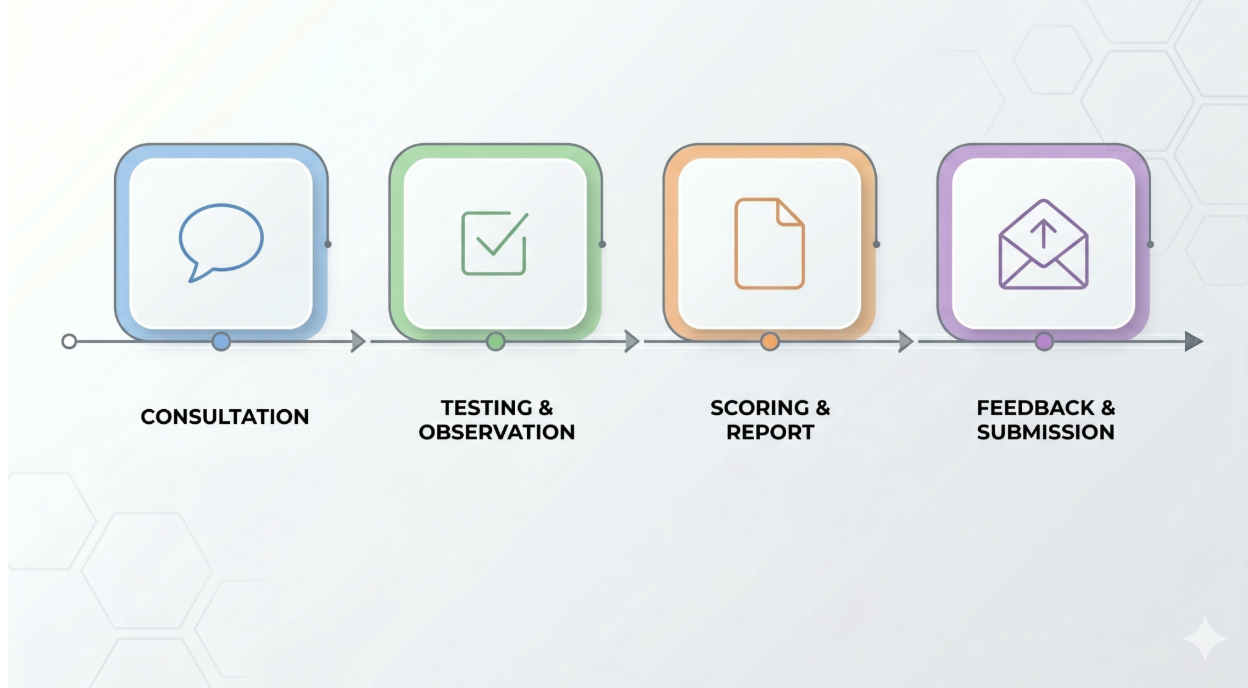
A psychoeducational assessment typically follows a structured process that takes anywhere from a few weeks to a few months. You should start this process at least six months before your exam date.
1. Referral and Consultation
The process begins with a consultation where you share what you are experiencing. We determine which high-stakes exam you are taking and confirm if an evaluation is the right fit.
2. Testing and Observation
Testing involves a mix of clinical interviews, self-report questionnaires, and standardized cognitive and academic tasks. Depending on your needs, we will measure intellectual ability, reading fluency, comprehension, math calculation, working memory, and processing speed. This can be completed via secure telehealth sessions.
3. Scoring and Report
Your data is analyzed and compiled into a comprehensive report. This document will detail your developmental history, diagnostic findings, and standard scores, and provide the crucial written justification required by the LSAC, AAMC, or the State Bar.
4. Feedback Session and Submission
We will hold a feedback session to review your results so you fully understand your cognitive profile. You will then submit the finalized report directly to your testing organization, which typically takes several weeks to process the decision.
FAQs
Does my childhood IEP guarantee exam accommodations?
No, it does not guarantee approval, but it is highly valuable evidence. If you previously received testing accommodations under an IEP or 504 Plan, testing entities like the College Board or ACT generally look favorably on this history. However, for graduate-level exams, you will still likely need an updated psychoeducational evaluation to prove your current level of functional impairment.
What is a functional limitation?
A functional limitation describes how your disability actually impairs your daily functioning compared to most people in the general population. For testing purposes, it means proving that your condition creates a specific barrier to taking the exam under standard conditions (e.g., your dyslexia causes you to read significantly slower than average, limiting your ability to finish a timed section).
Can I get accommodations for test anxiety?
Yes. Anxiety disorders can qualify for accommodations if they substantially limit your ability to concentrate or process information. However, normal "test jitters" do not qualify. You must have a documented disorder, and your evaluation must clearly show how the anxiety causes cognitive obstruction or memory retrieval issues during testing.