Why Your High School 504/IEP Doesn't Automatically Work for College Accommodations The Short Answer:
Why Your High School 504/IEP Doesn't Automatically Work for College Accommodations
The Short Answer: Your high school 504 plan or Individualized Education Program (IEP) officially expired the moment you graduated because the laws that govern K-12 education (IDEA) do not apply to higher education. In college, accommodations are governed by the ADA and Section 504, meaning schools are only required to provide equal access, not guarantee your academic success. To get college accommodations, you must proactively self-disclose your disability to your university's disability services office, submit acceptable documentation, and formally request support.
The Legal Shift: Why Your IEP or 504 Plan Expires After High School
Guaranteed Success vs. Equal Access
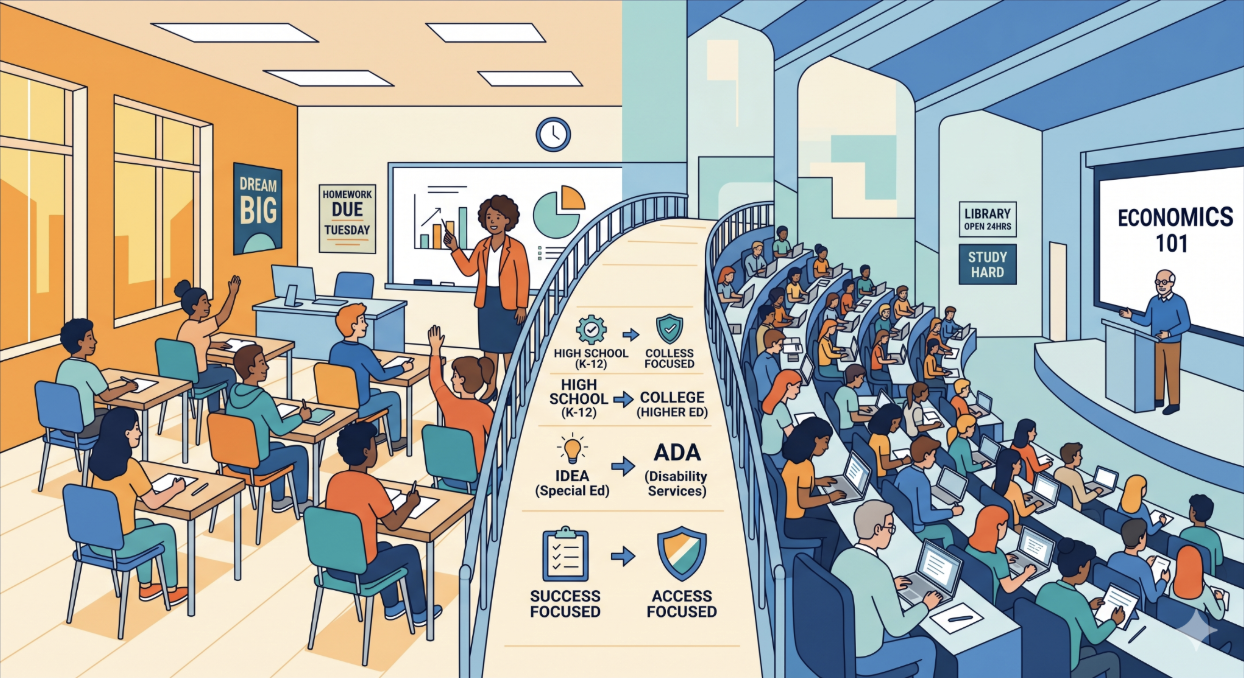
In high school, you were protected under the Individuals with Disabilities Education Act (IDEA), which required your school to identify your needs and provide specialized instruction to ensure you succeeded. College is entirely different. Higher education is governed by the Americans with Disabilities Act (ADA) and Subpart E of Section 504. These civil rights laws do not guarantee your success, nor do they force colleges to modify their curriculum; they simply ensure you face no discriminatory barriers to accessing your education.
You Are Now Your Own Case Manager
During high school, your parents and a dedicated case manager likely acted as the "CEOs" of your 504 or IEP, monitoring your progress and ensuring teachers followed your plan. In college, there are no case managers checking your grades or waking you up for class. Because of FERPA privacy laws, your professors and the disability office will not even speak to your parents about your academics without a signed waiver. You must become your own chief advocate.
How to Apply for College Accommodations Without Your 504 or IEP
1. Locate Your Disability Services Office
Colleges do not automatically know you have a learning difference, and they will not reach out to you. You must initiate the process by contacting the campus office responsible for accessibility (often called Disability Support Services, the Accessibility Office, or Student Accessibility Services).
2. Provide Updated Disability Documentation

While your old IEP or 504 plan can show a history of receiving services, most colleges do not accept it as stand-alone proof for accommodations. Universities typically require a comprehensive, recent psychoeducational evaluation (often completed within the last 3 to 5 years). If your documentation is outdated, scheduling a new evaluation is the necessary first step to clearly linking your current functional limitations to the specific college accommodations you need.
3. Complete the Intake Interview
Once you submit your documentation, you will have an intake meeting with an accessibility coordinator. This is not an interrogation; it is a collaborative conversation to discuss your academic barriers and determine which reasonable accommodations will best support your learning profile.
4. Deliver Your Letters of Accommodation
In high school, teachers automatically received your 504 or IEP. In college, the disability office usually provides you with a Letter of Accommodation (LOA), and it is your responsibility to deliver or electronically send this letter to each of your professors.
What College Accommodations Can You Actually Get?
Commonly Approved College Accommodations
Every student's profile is unique, but if your documentation supports it, disability services frequently approve:
- Extended time on exams and quizzes (usually 50% extra time)
- Testing in a separate, reduced-distraction environment
- Permission to record lectures or access to peer note-takers
- Priority registration to help you build an ADHD- or anxiety-friendly class schedule
- Assistive technology, such as text-to-speech software or audiobooks

Accommodations Rarely Approved in College
Colleges will not alter essential course requirements. Therefore, you should not expect to receive:
- Unlimited deadline extensions for assignments
- Modified grading scales or shortened research papers
- Teacher-created study guides
- Open-book exams (unless offered to the entire class)
The "3-A Transition Framework" for Securing Your Support

(Unique Information: Fresh Framework for Student Self-Advocacy)
Transitioning from a 504 or IEP to college-level independence requires a strategic approach. Use this "3-A Transition Framework" to take control of your academic success:
- Audit Your Paperwork: Do not wait until midterm week to realize your high school 504 plan is invalid. Audit your files the summer before classes start. If your last evaluation was in middle school, proactively book a telehealth psychoeducational evaluation to ensure your diagnostic report meets strict university ADA standards.
- Anticipate Your Barriers: Review your course syllabi on day one. Do you have a professor who grades heavily on fast-paced, in-class essays? Anticipate that your dysgraphia or slow processing speed will be a barrier and request your approved assistive technology (like speech-to-text) immediately.
- Activate Your Network: Accommodations only level the playing field; they don't replace studying. Activate your campus network by visiting your professor's office hours, joining a peer study group, and scheduling weekly appointments at the campus writing center.
Conclusion: Taking Charge of Your College Accommodations
Leaving your high school 504 or IEP behind doesn't mean you have to navigate your degree without support. By understanding the shift to ADA laws, gathering up-to-date diagnostic documentation, and practicing proactive self-advocacy, you can secure the college accommodations you need to thrive. If you are worried your current paperwork won't qualify, reach out to schedule an updated evaluation today so you can step onto campus with confidence.