
Testing Accommodations in California: Equal Access, Not an Unfair Advantage
Testing Accommodations in California: Equal Access, Not an Unfair Advantage
By Chelsea Quann, MS, LEP, PPS, licensed educational psychologist (#4640)
Testing accommodations are legally mandated adjustments that ensure standardized exams measure an individual's true aptitude rather than the effects of their disability. These modifications provide a level playing field, not a head start or unfair advantage. Below, we walk through the realities of exam accommodations, how they predict future success, and the exact steps to secure them for high-stakes tests.
The biggest hurdle I see for students preparing for a high-stakes exam is the stigma surrounding accommodations. Many brilliant students avoid seeking help because they feel receiving extra time or a quiet room is somehow "cheating." I wrote this guide to dispel that myth and empower you to claim the access you legally deserve under the Americans with Disabilities Act (ADA).
What Are Testing Accommodations in California?
Testing accommodations are changes to the regular testing environment and auxiliary aids that allow individuals with disabilities to demonstrate their true achievement level. The ADA requires testing entities—from college boards to professional licensing agencies—to offer exams in a manner that accurately reflects your knowledge, not any impairments resulting from a learning difference or medical condition like ADHD.
Common accommodations include:
- Extended testing time (e.g., 50% or 100% additional time)
- Extra or extended breaks
- A reduced-distraction testing room
- Screen reading technology or Braille
- Permission to use a computer for written essays
The Myth of the "Unfair Advantage"
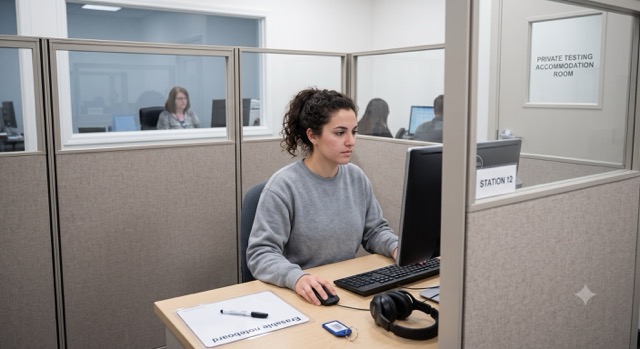
One of the most pervasive myths is that accommodations give test-takers a "leg up" over their peers. The data strongly refutes this.
Accommodations that do not alter the construct being measured yield valid, comparable scores. Research analyzing high-stakes tests like the Medical College Admission Test (MCAT) shows that scores obtained with extended time have comparable predictive validity to scores obtained under standard conditions. This means that a student with ADHD who scores a 510 with extended time is just as likely to succeed in medical school as a neurotypical student who scores a 510 under standard time. Accommodations simply remove the barrier of the disability; they do not inflate your underlying knowledge.
Who Qualifies for Accommodations on High-Stakes Exams?
You can qualify for accommodations if you have a physical or mental impairment that substantially limits a major life activity, such as learning, reading, concentrating, or thinking.
Commonly evaluated conditions include:
- ADHD: Difficulty sustaining attention or organizing/planning your responses under time pressure.
- Specific Learning Disorders: Dyslexia (slow reading), dysgraphia (difficulty with written expression), or dyscalculia (impaired math calculation).
- Psychiatric Disorders: Severe test anxiety, depression, or PTSD that causes cognitive obstruction.
- Medical Conditions: Visual impairments, traumatic brain injuries, or motor impairments.
A critical note for high achievers: A history of academic success does not mean you do not have a disability. According to the ADA, someone with a learning disability may achieve a high level of academic success but still be substantially limited because of the significant extra time or effort they must spend to learn compared to the general population.
The California Bar Exam and Other State Testing Boards
Testing boards in California, such as the State Bar of California, have rigorous documentation requirements. If you are applying for accommodations on the Bar Exam, the board places heavy consideration on your history of past accommodations (like those received in law school).
However, simply submitting a diagnosis is never enough. To secure testing accommodations in California, your evaluator must provide a clear "nexus"—a detailed explanation directly connecting your disability-related functional limitations to the specific accommodation requested. If you are recommending greater than 100% additional testing time or a private room, the State Bar requires an exceptional justification explaining why standard accommodations are insufficient.
Is Extended Time Always Best?
Many students automatically assume that extended time is the ultimate solution to their testing struggles. However, more time is not always the best answer. Having more time to ruminate, second-guess yourself, or go down an unhelpful line of thinking can actually cause fatigue and worsen performance. Testing agencies, like the AAMC (which administers the MCAT), view extended time as an accommodation strictly for processing test content (e.g., for slow reading or processing speed deficits).
If your primary challenge is managing your attention or regulating anxiety, "stop-the-clock" breaks are often far more effective. These extra breaks allow you to rest, use coping strategies, or take medication without eating into your active testing time. Requesting the wrong type of accommodation can lead to outright denials, which is why a thorough evaluation is essential.
How to Apply for Testing Accommodations
Securing accommodations requires careful planning and comprehensive documentation.

1. Schedule a Psychoeducational Evaluation
Start by scheduling a comprehensive evaluation with a qualified professional, such as a licensed educational psychologist or neuropsychologist. A brief doctor's note is generally not sufficient. Testing organizations require objective measurement of your cognitive abilities, academic achievement, and processing speed.
2. Establish the Functional Limitation
Your evaluation must demonstrate a "functional limitation". This means proving that your condition creates a specific barrier to taking the exam under standard conditions, such as reading significantly slower than the average person in the general population.
3. Submit a Clear Rationale
Every requested accommodation must be explicitly linked to your objective test data. Your evaluator will compile a comprehensive report detailing your developmental history, psychometric scores, and a written justification for each accommodation. You then submit this finalized report directly to your testing organization.
FAQs
Does my childhood IEP or 504 Plan guarantee exam accommodations?
No, it does not guarantee approval, but it is highly valuable evidence. Proof of past testing accommodations in similar test settings is generally sufficient to support a request for the same testing accommodations on a current standardized exam. However, for adult high-stakes exams, boards will still want to see that your documentation is current (usually updated within the last 3 to 5 years).
Can I get accommodations for test anxiety?
Yes. Severe anxiety disorders can qualify for accommodations if they substantially limit your ability to concentrate or process information. The anxiety must be a documented psychiatric disorder, and your evaluation must clearly show how it impairs your test-taking functioning. Normal test jitters do not qualify.
How long does the evaluation process take?
The entire process from the first consultation to the final report delivery typically takes a few weeks to a few months. However, because testing agencies can take up to 60 days to review your application, it is highly recommended to start the process at least 6 months before your intended exam date.
About the Author: Chelsea Quann, MS, LEP, PPS, is a licensed educational psychologist (#4640) specializing in comprehensive psychoeducational evaluations for high-stakes testing accommodations. Visit www.blueprintevaluations.com to learn more or schedule a consultation.